Both arms passed every compliance test. Neither one can hold onto what it picks up.
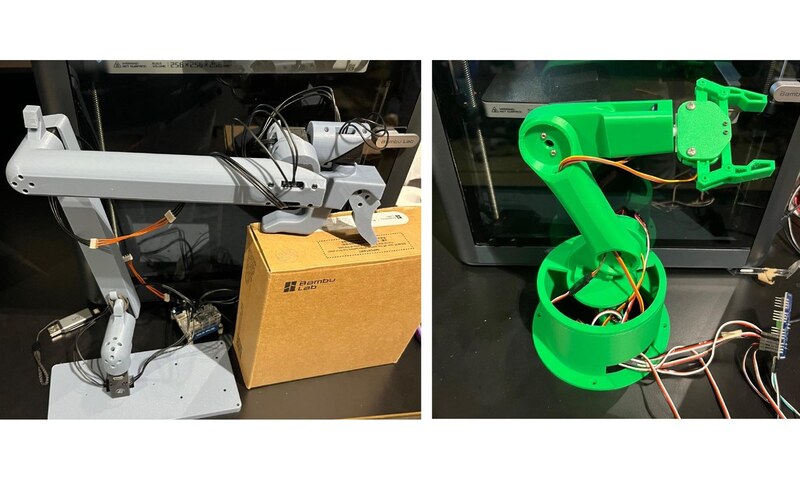
Angel Adeboye, Daniel Aguilar, Henry Bokma, and Zach Montiel spent the summer building two robotic arms with nothing in common by design. UR5 mirrors an operator's motion: move a controller, and the joints copy it in real time. Jarvis takes no controller at all; say a joint name and an angle out loud, and the arm turns to match, with no human hand in the loop. The four-student team, part of Biola University's Summer Engineering Internship (SEI), built the pair specifically to test one control scheme against the other on hardware assembled side by side rather than years apart.
By June 22, both arms had cleared every compliance test on the project poster. UR5 repeated an operator's motion exactly on June 10. Jarvis responded correctly to spoken commands on June 15, its motors rotated freely, and its gripper opened and closed on command. Two entirely different control philosophies, tested five days apart, both worked as designed.
Then the team logged the one thing neither arm could do: hold onto an object it had already reached. A teleoperated arm and a voice-controlled arm, built independently by the same team, arrived at the same failure point.
Two Theories of Control
The first arm, UR5, is a half-scale kinematic replica of the commercial Universal Robots UR5, built on the open-source GELLO design and driven entirely by an operator's own movements. Seven Dynamixel motors and eight 3D-printed parts translate a human arm's motion into the robot's joints in real time, the same teleoperation approach used in selective indoor-farm harvesting and medical-equipment assembly.
The second arm, Jarvis, answers to speech instead. It is the third rebuild of a prototype the SEI has carried forward since 2022, now running wireless voice control through an ESP32-C3 board: name a joint, name an angle, and the arm executes it without a human hand in the loop. That control scheme is closer to what lab automation and embodied AI training systems use today. The team built both arms in the same summer, under mentors Dr. Nathan Cho and Prof. Todd Curtis and client Dr. Grace Ni, which meant testing an operator-driven control scheme against a voice-driven one on hardware assembled side by side, not years apart.
The Build Sheet
UR5 came in at $301.88, built from Dynamixel motors and printed parts, run from Terminal on a mix of Python and C++. Jarvis cost $108.43 to rebuild, cheaper because it inherited a gripper and base concept from prior years rather than starting from raw stock, and it runs entirely in C++ through the Arduino IDE. The four-student team spent the summer machining parts, wiring the ESP32-C3 board, and debugging two arms in two different languages before either one moved on command.
What the Test Log Admits
Four compliance tests passed. UR5 successfully repeated an operator's motion on June 10. Jarvis responded correctly to voice commands naming joints and angles on June 15, its motors rotated freely, and its gripper opened and closed on command through June 22.
Then the team logged what didn't work. Both arms struggle to grasp objects. UR5 is too top-heavy to stand upright without help. Neither problem is hidden in a footnote; both sit next to the passed tests, on the same poster, in the same font: a system that moves correctly and still cannot reliably pick something up.
The 2.5-Pound Bar
The team's next milestone is concrete: get both arms lifting at least 2.5 pounds without failing, then put them to work on real classroom tasks, holding a chemistry flask steady or supporting an engineering demo. Neither arm has been tested against that bar yet. The compliance tests that passed prove the control logic works; the 2.5-pound test is the one that will show whether either arm can carry a chemistry flask across a room without dropping it.
More from the SEI 2026 cohort:
The team that built a swim tunnel to study zebrafish behavior, and had to solve a fluid dynamics problem before they could solve a biology one.
A literature review that picked a suspension architecture for an off-road race vehicle using a parameter Biola Racing's own engineers hadn't formally defined yet.
A water desalination upgrade for a humanitarian client in Colombia where swapping one pipe material for another improved condensation by 550%.
See more from the SEI and RISE summer programs.
If you are trying to figure out what a Biola engineering student actually builds before junior year, or whether Biola.io can run a hardware project the way it ran this one, here's what this project tells each of you.
If you're a prospective student: This is what the SEI hands lower-division students, real hardware, a real budget, and a test log with your name on the failures as well as the successes. The on-ramp starts with an application to the SEI itself, not an upperclassman research seat; Adeboye, Aguilar, Bokma, and Montiel were doing kinematics and embedded control work before their junior year.
If you're evaluating Biola as a donor: This is the fourth SEI 2026 robotics and engineering project to reach a public writeup this summer, alongside the Lunar Lander Navigator, Zebrafish Smart Tunnel, and ATV Suspension teams. That is a program producing a steady rate of hardware output, not a single showcase project built for the poster session.
If you're an industry partner: This is the shape of problem biola.io can run for you, a hardware build with a fixed summer timeline, a defined budget, and a written test log that reports failures alongside passes. If you have a prototype that needs to go from idea to testable hardware in one summer, this is the playbook.
Learn more about the Engineering, B.S. program at Biola University.