Biola's Summer Engineering Internship gives freshmen and sophomores eight weeks to work on engineering problems for real clients.
Most engineering students wait until senior year for a project with a real client and a real deadline. Our students do not wait that long. Every summer, our Summer Engineering Internship (SEI) puts freshmen and sophomores in front of an actual client. That often happens before they have even picked a concentration. Over eight weeks, each team designs, builds and presents something that works, and in 2026, 11 student teams did exactly that. A published outcomes survey shows how students are transformed along the way.
The range of work this year was wide. One team built a GPS-independent navigation system for a lunar lander. Another redesigned a research tank for zebrafish. A third built custom controllers for two Biola students with muscular dystrophy. A fourth designed enrichment toys for captive sharks at Cabrillo Aquarium. A fifth kept refining a water system bound for rural Colombia.
Why SEI Exists
Before Fall 2023, Biola University had no engineering degree. No major on campus offered a project-based engineering curriculum, either. Students could study physics, computer science or math. But most did not touch a real client project until senior capstone, if they reached one at all. Our engineering faculty built SEI to close that gap. It gives freshmen and sophomores that same client-facing experience years earlier. With three or four years still ahead of them, they can use what they learn. They can change direction, or go deeper into what the project revealed they were good at.
How It Works
SEI runs 16 hours a week for eight weeks, 128 hours total. Every team starts the same way: client interviews. The goal is to learn what the client actually needs which is not always what they first ask for. From there, the process moves through design, prototyping and testing. It ends with a public poster session, where teams present a working result.
Clients might be a Biola faculty member running a research lab, or a Biola athletics program. It could also be an outside organization with a real problem to solve. Two faculty mentors and a designated SEI Worker then guide each team. They do not do the work for the students.
Along the way, students train in hard skills: Arduino programming, computer-aided design (CAD) and 3D printing. They also train in soft skills: building a resume, giving presentations and running a project with SCRUM, a method borrowed from professional software teams.
The Student Transformation
In 2024, SEI co-founder Dr. Grace Ni and Dr. Elaine Wong published "A Summer Engineering Internship Program Offered at a Liberal Arts University" through the American Society for Engineering Education. It surveyed 16 of the program's 31 former students from 2021 through 2023. The results measure something we call time to value. That means how quickly a student becomes someone a client can actually rely on.
Before SEI, 75% of students rated their testing and validation skills at basic knowledge or below. Afterward, 87.6% rated themselves competent or better. Client interaction moved from 81.3% to 93.7% competent or better. Documentation moved from 62.5% to 81.2%. Command of the full engineering design process moved from 68.8% to 93.7%. CAD and 3D printing skills started higher than the rest. Many students already had some design software experience. That number moved from 81.3% to 75% competent or better.
Seven of 11 students from the 2021 and 2022 cohorts landed external engineering internships. That is about 64%. Ten of 13 respondents said SEI made them feel more confident interviewing for one.
The biggest gains showed up in testing, documentation and client interaction. Those are the parts of engineering that call for judgment, not a formula. AI can generate a CAD file or a control script in seconds. It cannot sit across from a client who does not fully know what they need. It cannot turn that into a working system nor can it watch that system fail a test and decide what to fix next. That is the loop SEI builds.
The 2026 Cohort
Eleven client-driven projects made up the 2026 SEI cohort.
| Project | Description | Investigators |
| Lunar Lander Navigator | The team built and tested a proof-of-concept lunar lander navigation unit. It combines lidar and sonar to map and navigate nearby terrain without GPS. | Henry Bokma, Kevin Slack, Christian Meineke, Daniel Aguilar |
| Zebrafish Swim Tunnel | Working with Dr. Hyuna Lee, the team redesigned a zebrafish swim tank for steady current flow, steady temperature and easier use. | Jonas Magos, Gabriel Losh, Izzy Tellez, Emilio Ramirez |
| Life Giving Water International Desalination System | The team refined a desalination system a prior Biola capstone team designed for rural Colombia. Testing proved difficult, but the team still improved the design. | Ho Hei Ng, Clara Zhao, Emilio Ramirez |
| Baja SAE Suspension | The team built the design and testing process Biola Racing needs for its next Baja SAE vehicle's custom suspension. | Emilio Ramirez, Ho Hei Ng, Lincoln Tenney |
| Educational Robotic Arm Fabrication | The team built a half-scale replica of a Universal Robots UR5 arm for Biola classes. They also added voice control to another of Biola's educational robotic arms. | Henry Bokma, Zach Montiel, Angel Adeboye, Daniel Aguilar |
| Accessible Scale for Wheelchair Users | The team built a custom scale that fits under a kitchen chair and folds away, so a wheelchair user can weigh themselves at home. | Jonas Magos, Christian Meineke, Clara Zhao |
| Assistive Communication Device Control | The team partnered with two Biola students who have muscular dystrophy. They built custom controllers each student could reliably use with their own communication device. | Aiden Burr, Lincoln Tenney, Gabriel Losh, Ho Hei Ng |
| Educational Larynx Model 2.0 | Building on an earlier SEI team's work, the team built a model larynx that shows how its anatomy and muscles work, for use as a teaching tool in Biola classes. | Aiden Burr, Lincoln Tenney |
| Custom Aquarium Shark Toy | With Cabrillo Aquarium, the team designed and tested toys for captive sharks, to support Dr. Patrick Sun's research on enrichment for the animals. | Kevin Slack, Izzy Tellez, Clara Zhao |
| Humidity Management for Biola Observatory | The team built an automatic humidity control system for the Biola Observatory. It switches on a fan or dehumidifier once humidity crosses a set level. | Zach Montiel, Angel Adeboye, Aiden Burr |
| Zebrafish OKR Drum | With Dr. Hyuna Lee, the team built on earlier work to construct a rotating drum that tests a zebrafish's response to motion. | Zach Montiel, Angel Adeboye, Aiden Burr |
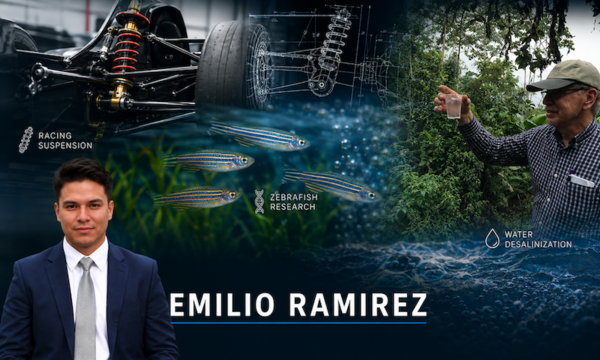
Emilio Ramirez, a junior studying mechanical engineering, describes his summer experience working three SEI projects at the same time.
In Their Own Words
Henry Bokma, a sophomore studying robotics engineering, was assigned to two projects: a GPS-independent lunar rover and Jarvis, a voice-controlled robotic arm now in its third rebuild, dating back to SEI 2022.
"Biola's SEI program threw me right into the thick of hands-on engineering experience," Bokma said. "Throughout the program, some of the many technical skills I learned were computer-aided design, software development, circuitry, soldering, 3D printing, and assembly. … In particular, I enjoyed developing a functional navigational rover, as well as a voice-controlled robotic arm named Jarvis."
Izzy Tellez, a sophomore, split her summer between the Zebrafish Swim Tunnel and the Custom Aquarium Shark Toy project.
My experience at SEI was incredibly fun to participate in alongside my engineering peers and friends. I was able to gain experience in SolidWorks and 3D printing through my shark toy and zebrafish tank project that will help pave the way for my journey as an engineer."
Lincoln Tenney, also a sophomore, worked on the Baja SAE Suspension team while contributing to two of the cohort's other projects.
My name is Lincoln, and the Summer Engineering Internship was a great gift in many ways. The program helped me combine commitment to excellence with Kingdom passion in my work. My career vision also gained clarity through the program, and I am now more equipped to discern valuable opportunities and engage in them successfully.
SEI is not the only summer opportunity in Biola's School of Science, Technology and Health (SSTH). Students in the Stewart Honors Program can also apply for RISE (Research and Internship Summer Experience). RISE students work alongside faculty as Stewart Fellows on existing research. Topics range from sleep and metabolism studies to zebrafish neuroscience.
A lunar rover. A water system bound for Colombia. A robotic arm named Jarvis. SEI students get a client and a deadline on projects like these while most of their peers are still choosing a major. That head start is exactly what SEI was built to give students. Eight weeks will not make anyone an engineer. It is enough time to find out what being one actually takes.If it sounds like the engineering education you want, explore the Engineering B.S. at Biola.