Three engineering students in Biola University's Summer Engineering Internship (SEI) upgraded a solar distillation unit for Life Giving Water International, a Christian NGO serving brackish-well communities in La Guajira, Colombia. Switching to copper condenser pipes alone improved condensation by 550%.
La Guajira, Colombia sits on a peninsula where the water underground is brackish: too salty to drink, too mineral-heavy to use without treatment. Life Giving Water International (LGWI), a Christian NGO, has been working to change that. The organization partnered with Biola University to design a solar distillation system that would turn brackish well water drinkable without electricity, without imported parts, and at a cost families in the region could sustain.
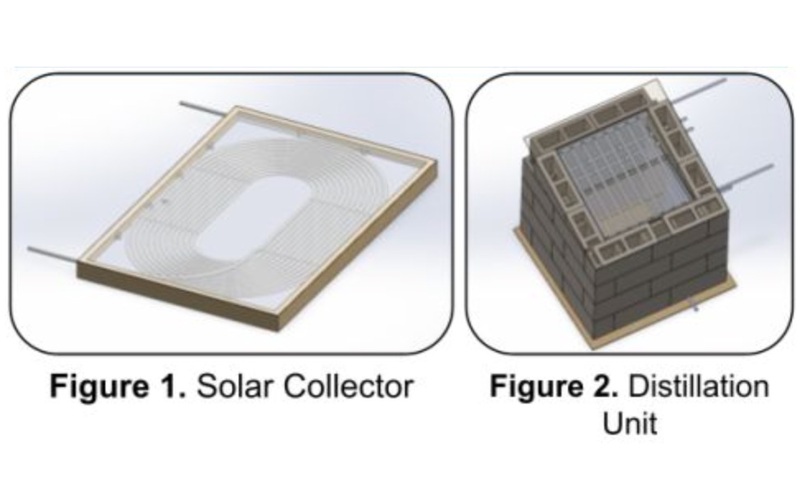
A Biola senior capstone team built the first version. Their system used a solar collector built from a reflective box, a plexiglass cover, and black polyethylene tubing to heat the input water, then passed it into a distillation unit that extracted the salt through evaporation and condensation. It worked. The recovery rate was approximately 1%. The target was 5%.
That gap is what three students in Biola's SEI 2026 were asked to close.
Life Giving Water
Ho Hei Ng, Emilio Ramirez, and Clara Zhao did not touch the solar collector. The capstone team's work on that component stood. Their focus was the distillation unit: a 26-inch by 26-inch by 36-inch chamber where steam rises, condenses on a cooled surface, and drips into a collection system. Five design objectives governed every decision: the output had to contain no more than 200 milligrams of salt per liter, use no electricity, rely on locally sourced materials, and be modular enough to scale. A sixth constraint shaped all the others: the community in La Guajira had no access to specialized manufacturing or replacement parts. Whatever the team built had to work with materials someone there could find.
The Distillation Unit
The team made six changes. They replaced the existing polyurethane condenser pipes with countercurrent S-shaped copper pipes, added galvanized hardware cloth to increase evaporation surface area, raised the polystyrene divider to improve steam circulation, added fitted polystyrene lid insulation, applied weatherstripping to seal the chamber, and built a PVC collection system.
The copper pipes were the most significant change. Copper conducts heat approximately 10,000 times better than polyurethane, a difference that shows up directly in how efficiently steam condenses. When the team analyzed their designs using a structured design-of-experiments approach, pipe material turned out to be the dominant factor by a wide margin.
"Designing a distillation system for a community without reliable water access put every engineering decision in context," said Ramirez. "I strengthened my skills in engineering design, computer-aided design (CAD) modeling, and rapid prototyping, and gained a deeper appreciation for what it means to use engineering to improve lives." Of mentors Prof. Todd Curtis, Dr. Nathan Cho, and Matthew Chang, he said: "Their guidance challenged me to think more critically and approach problems as an engineer."
What the Numbers Showed
Across design iterations, condensation improved by more than 550%. The team measured condensation on a 0–10 scale and identified three significant factors: pipe material, divider position, and the temperature gap between the input water and the coolant. Pipe material had the largest effect: copper-condenser designs scored 6.25; polyurethane designs scored 2.35. The 3.9-point difference between them was larger than any other factor's contribution.
The team's best result using the old collection system produced approximately 10 milliliters of distilled water per hour. The team did not complete a custom collection system for the new copper condenser before the project ended, so the full yield of the copper-pipe design was not measured.
What Comes Next
Before the system moves toward field deployment, six improvements have been identified: a collection system sized for the copper condenser, more coolant tubing, marine-grade hardware cloth, food-grade conductive pipes, a solar-powered fan, and a full test of the solar collector and distillation unit together.
A distillation unit built from locally available materials, using no electricity, can reduce brackish water to a drinkable salinity level. Getting the recovery rate to the 5% target requires further optimization, but the critical variable has been identified.