The Quantitative Consulting Center (QCC) takes on real statistical consulting projects for organizations that need answers, not homework.
When an organization brings a data problem to the QCC, it lands with an advisor-led undergraduate team who then scope the engagement, choose the methods, and deliver findings the client can act on.
When an organization brings a data problem to the QCC, it does not go to a graduate lab or get farmed out to a contractor. It goes to an advisor led undergraduate team in Biola's Department of Mathematics, working under faculty supervision, who scope the engagement, choose the methods, and deliver findings the client can act on. That is how our students have ended up working with clients from Major League pitching analyst Perry Husband to building statistical models for Lawrence Livermore National Laboratory.
What the QCC Does
The Quantitative Consulting Center (QCC) is housed in our Department of Mathematics and runs through the Statistical Consulting Practicum, the course where client engagements are scoped and delivered. Organizations bring us a real problem. A dataset that needs modeling, a hypothesis that needs testing, a question they cannot answer internally and our students build the solution from the ground up: defining the analytical approach, running the models, and presenting results the client can use.
Not every engagement becomes public. Some client work is confidential by agreement, and we do not disclose the specifics of projects under NDA. What we can say is that the range of organizations willing to put real problems in front of an undergraduate team, confidentially, tells you what they think of the work.
How It Works
Every engagement starts with a free initial consultation, where our team assesses the problem and scopes the work. From there, QCC engagements draw on three service areas, matched to what the client actually needs:
Design — For clients who haven't collected data yet, our students help build the survey, design the experiment, and choose the right data collection methods before analysis starts.
Analysis — Our students analyze new or existing client data using classical statistical methods and standard machine learning techniques, working in R, Python, Tableau, SPSS, or Excel depending on what the problem calls for.
Reporting — Findings come back as a written report, a slide presentation, or another format the client requests, built for the audience that has to act on it.
Consulting fees are based on estimated time and resources. On-campus partners get 10 free consulting hours a semester, and Christian ministries are never charged.
Led by Dr. Jason Wilson
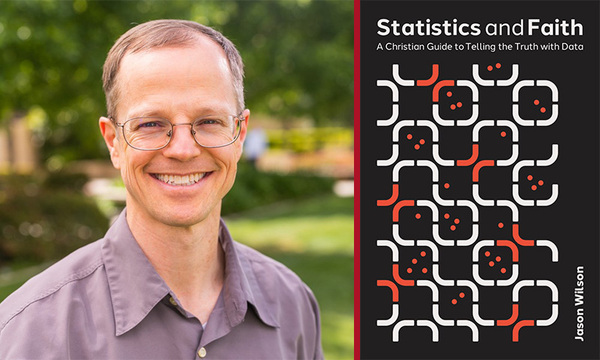
The QCC is directed by Dr. Jason Wilson, professor of statistics in our Department of Mathematics. Wilson holds a PhD in statistics from UC Riverside, has published more than 20 peer-reviewed journal articles, and co-invented the Quality of Pitch (QOP) statistic, a baseball analytics metric presented at the 2015 SABR convention and cited in Wikipedia's Pitch Quantification article. In May 2026, he published Statistics and Faith: A Christian Guide to Telling the Truth with Data through IVP Academic, arguing that statistical integrity and Christian intellectual honesty demand the same discipline: precision about the data is precision about the truth. That is the standard he holds QCC engagements to.
Client Work, Not Case Studies
Two QCC engagements are public and illustrate the range of the work.
The Data Behind Baseball's Hardest Problem — A QCC team ran 3.2 million MLB pitches through a custom statistical function to independently test Perry Husband's Effective Velocity theory. Both of Husband's core hypotheses held up, including a hard-hit ball clustering rate that exceeded his own benchmark.
Biola Students Solved Lawrence Livermore's Particle Size Problem — Four QCC students sat in on security-protocol calls with Lawrence Livermore National Laboratory scientists and built the regression models that identified which manufacturing variables control the particle size of TATB, a material used in the U.S. nuclear stockpile.
More engagements are added to this page as they clear client review. The full, frequently updated project list — including work not yet summarized here — is maintained at biola.edu/quantitative-consulting-center/projects.
If You Have a Problem for Us
We take on new client engagements throughout the academic year for businesses, nonprofits, and research institutions. If your organization has a data or statistics problem worth solving, engage the QCC →
If You're Considering Biola
The QCC exists so Biola students can get real-world data consulting experience before they graduate. If you'd like to learn more about Biola's Math Department, you can click here. Explore the Mathematics BS →