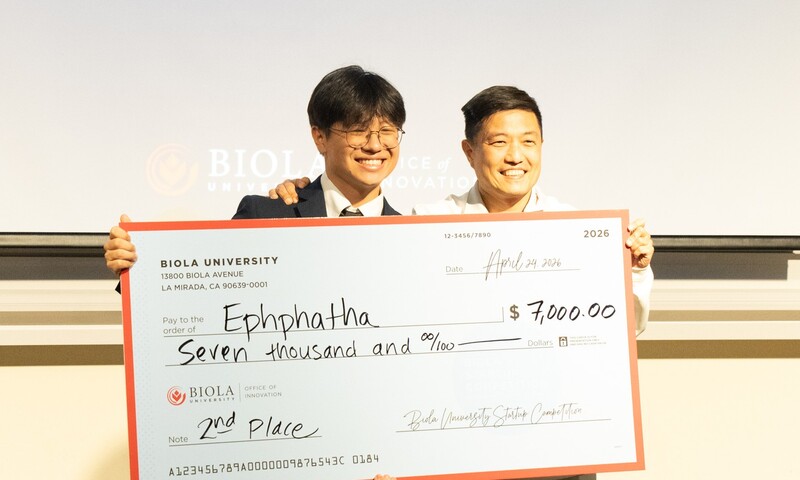
Four computer science students from Biola University entered the 12th Annual Biola Startup Competition and placed second, winning $7,000. The team was Ephphatha. The product they built is designed to close one of the most persistent gaps in how churches serve Deaf and hard-of-hearing members of their congregations.
The competition was organized by the Biola University Office of Innovation. The 2026 event drew 242 attendees and distributed $27,000 in seed capital to winning teams. Judges at a Biola University student startup competition were looking for early-stage ventures with real users, real problems, and working solutions. Ephphatha had all three.
What Ephphatha Built
The problem Ephphatha set out to solve: most churches cannot reliably provide ASL interpretation at every service. Many rely on volunteers who can cover some services but not all. When a congregation grows, adds a second service, or begins live streaming, the coverage gap grows with it. Deaf and hard-of-hearing members who want to follow a sermon, participate in a prayer, or experience worship as fully as hearing members often cannot.
Existing solutions are either expensive or incomplete. Human interpreters require scheduling, coordination, and cost. Closed captioning renders words as text but misses the grammar and expressiveness of American Sign Language, which is a distinct language with its own structure. Neither scales easily to the range of contexts a church encounters in a single week.
Ephphatha is an AI-powered system that translates live speech into American Sign Language in real time, delivered through an expressive avatar on screen. The system listens to live audio and generates ASL continuously. It is rendered through a digital figure designed to communicate naturally, not mechanically. The avatar is the key distinction: it reproduces the facial expressions, hand shapes, and movement that make ASL comprehensible, rather than reducing the language to a flat transcription.
The scope of the product is deliberate: sermons, prayers, and songs. Full participation in a worship service, not just access to the spoken word.
The team described the product's purpose directly: "Ephphatha brings real-time Voice-to-ASL translation using an expressive avatar so Deaf and Hard-of-Hearing congregants can experience sermons, prayers, and songs live."
The Team
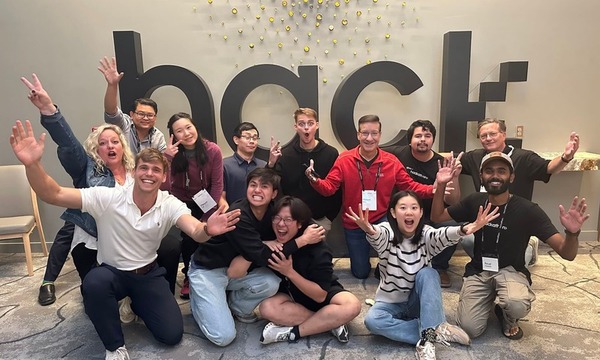
Matteo Mellilo, En Duo Wang, Ryan Ong, and Caleb Ayers are computer science students at Biola University's School of Science, Technology and Health. The project did not start as a business plan. It started as a hackathon entry.
Where It Started
In October 2025, the team entered the GLOO AI Hackathon in Boulder, Colorado. GLOO is a faith-technology organization focused on AI's role in advancing the global church's mission. The hackathon drew 98 competing teams from 48 states and 27 countries around the theme "AI for Human Flourishing." Nine awards were available. Ephphatha won the Hacker's Choice Award, a peer vote among all 98 competing teams, and $5,000.
A hackathon tests whether a product works under time pressure. Winning the Hacker's Choice Award means the people in the room who were also building thought Ephphatha was the most compelling thing they saw. That vote comes from people who know what it takes to build.
Seven months later, the team entered the Biola Startup Competition. The two events test different things. A hackathon is about execution: can you build it? A startup competition is about viability: is this a real venture? Biola's event brought in judges evaluating early-stage projects against real criteria: Is the problem substantial? Is the solution viable? Can it scale?
They placed second and won $7,000.
The pitch framed the product's purpose directly: restoring dignity and expanding accessibility for Deaf and hard-of-hearing people. That framing is the difference between a clever technical exercise and a startup worth funding. Ephphatha was already the latter by the time the team walked into the competition.
What It Adds Up To
From a single hackathon weekend to the Biola Startup Competition podium, Ephphatha accumulated two competition wins and $12,000 in prize money. Different audiences, different formats, two wins. Hackathon peers voted it the most compelling build in a field of 98 teams. Startup judges backed it with real seed capital.
The team is still building.