Inside Biola's Summer Engineering Camp, where high school students design and build working automatons in five days, guided by a professor who sees physics as a window into creation.
On the last afternoon of Biola's Summer Engineering Camp, one student from the week's cohort presented a fully assembled Mars rover. He'd had no SolidWorks experience when the camp started.
The camp ran July 19 through 24, 2026, at Biola University, a Christian university in La Mirada, California. Organized by the School of Science, Technology and Health (SSTH), the week-long program brought together high school students in grades nine through 12 for an intensive introduction to engineering design: concept to working prototype in five days, using SolidWorks computer-aided design (CAD) software, 3D printers, laser cutters, motors, gears, and control boards. No prior engineering experience was required.
Gears, Saxophones, and One Mars Rover
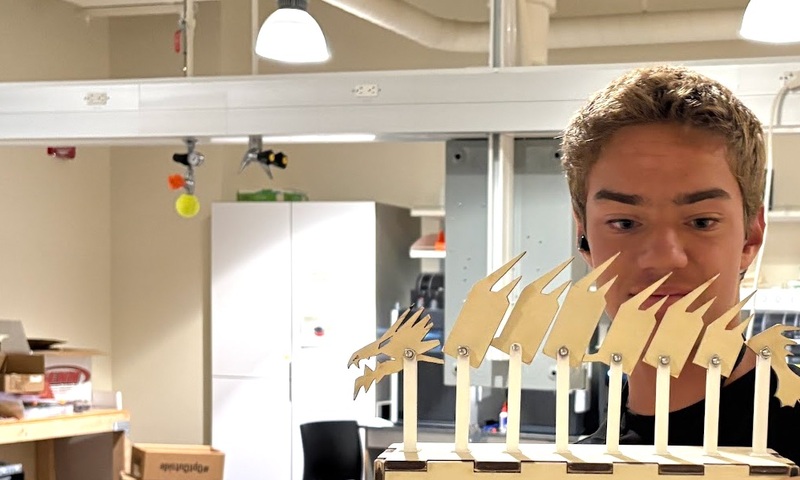
Each student chose their own project. The only constraint: design something that moves.
Skyler plays in a marching band and decided to recreate one in miniature, complete with gears, painted figures, and saxophones scaled to represent her section. Erilyn had never used SolidWorks before and spent the week learning how to make gears mesh the way she'd imagined. "It was really cool figuring out how to make all the gears connect and work together," she said. Everett, interested in renewable technology, built a working windmill and described the moment it moved for the first time as "probably the best part." Justin made a pink-and-green animatronic figure on crutches that he described, in his own words, as having "some personality."
"One student came in with SOLIDWORKS experience and took it to another level by building an entire Mars rover," said Prof. Todd Curtis, the camp's lead instructor. "It was mind-blowing to see what he accomplished in such a short time."
The Mars rover and the marching band had different starting points. What they shared was a personal question behind the project: something each student actually cared about, built into moving parts and presented in front of an audience by the end of the week.
The Question That Brought Him Here
Todd Curtis has taught physics at Biola for years, but his reason for teaching at a Christian institution is older than any particular course.
In college, a physics professor once asked him, in what Curtis describes as a loving and caring way, how he could be a Christian and study physics. The professor saw the two as incompatible. Curtis did not. For him, faith and science had been growing alongside each other for as long as he could remember, and the question sharpened rather than threatened what he already believed. "The challenge that question provides us and our culture and Christians today is part of why I'm here," he said.
His answer to the question, in his own words: "What we're studying isn't just physics but really a description of how God created the world to work. As a result we see aspects of his nature." That conviction is the reason he chose a Christian institution. He wanted to be somewhere he could teach both the subject and the questions it raised.
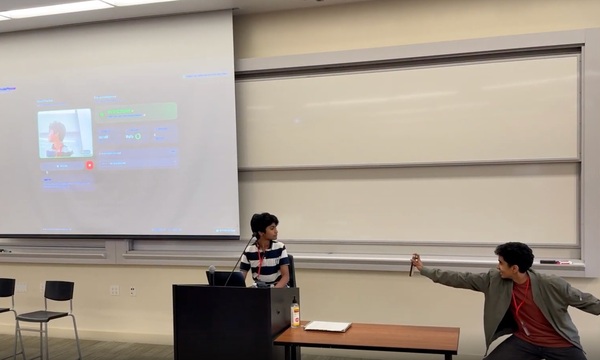
At the Engineering Expo, watching students present what they'd built in five days, that conviction expressed itself differently. "These students were creating things I never would have imagined, even though many were completely new to SOLIDWORKS," he said. "They brought a fresh perspective that we, as adults, sometimes don't see."
Every Time Something Didn't Work
The projects at the Expo were finished, and each one had spent most of the week not working. "This week taught me how much engineering is about testing ideas and solving problems," said Nicholas. "Every time something didn't work, I learned something new." Liz put the same experience in terms of what she could do. "I learned so much in such a short amount of time," she said. "By the end of the week, I was able to make things I wouldn't have known how to start before."
About the Camp
Biola's Summer Engineering Camp is open to high school students in grades nine through 12. No prior engineering experience is required, and the program is designed to accommodate both beginners and students with prior exposure to design software.
The 2026 camp offered two options: an overnight option at $1,000, which included lodging in suite-style dorms on campus, meals, lab supplies, and evening activities; and a day camp option at $700, which included lunch and lab supplies. Partner school discounts were available for students from Whittier Christian High School, Crean Lutheran High School, Western Christian Schools, Grace Brethren High School, Pacifica Christian High School, and Valley Christian San Jose. Airport shuttle service from LAX was available for students traveling to campus alone.
The camp is expected to return in 2027. Registration details will be posted at biola.edu as dates are confirmed.