Four engineering students in Biola's Summer Engineering Internship redesigned an existing swim tunnel into a $515 touchscreen-controlled research instrument with real-time flow measurement and validated laminar conditions.
For zebrafish behavioral research, the instrument at the center of every experiment is a swim tunnel. It works like a treadmill: water moves through a sealed channel at a controlled rate, fish swim against the current, and researchers observe their response. The tunnel already in use at Biola University's biology lab was functional in the most basic sense. It could push water through a channel. What it lacked was the sensors and adjustability that make an observation worth recording.
During the summer of 2026, four engineering students at Biola's School of Science, Technology and Health (SSTH) rebuilt it. Gabriel Losh, Jonas Magos, Emilio Ramirez, and Israel Tellez worked through the Summer Engineering Internship (SEI), a Biola program that places underclassmen into client-driven research projects. Zebrafish are widely used in biomedical research for their genotypic similarity to humans; the students' clients were two Biola faculty members who needed a tool that could produce reliable data: Dr. Hyuna Lee, an associate professor of biological sciences, and Dr. Brent Peterson, co-program chair and associate professor of kinesiology and public health. The assignment: rebuild it so the data would be worth collecting.
The Treadmill Without a Speedometer
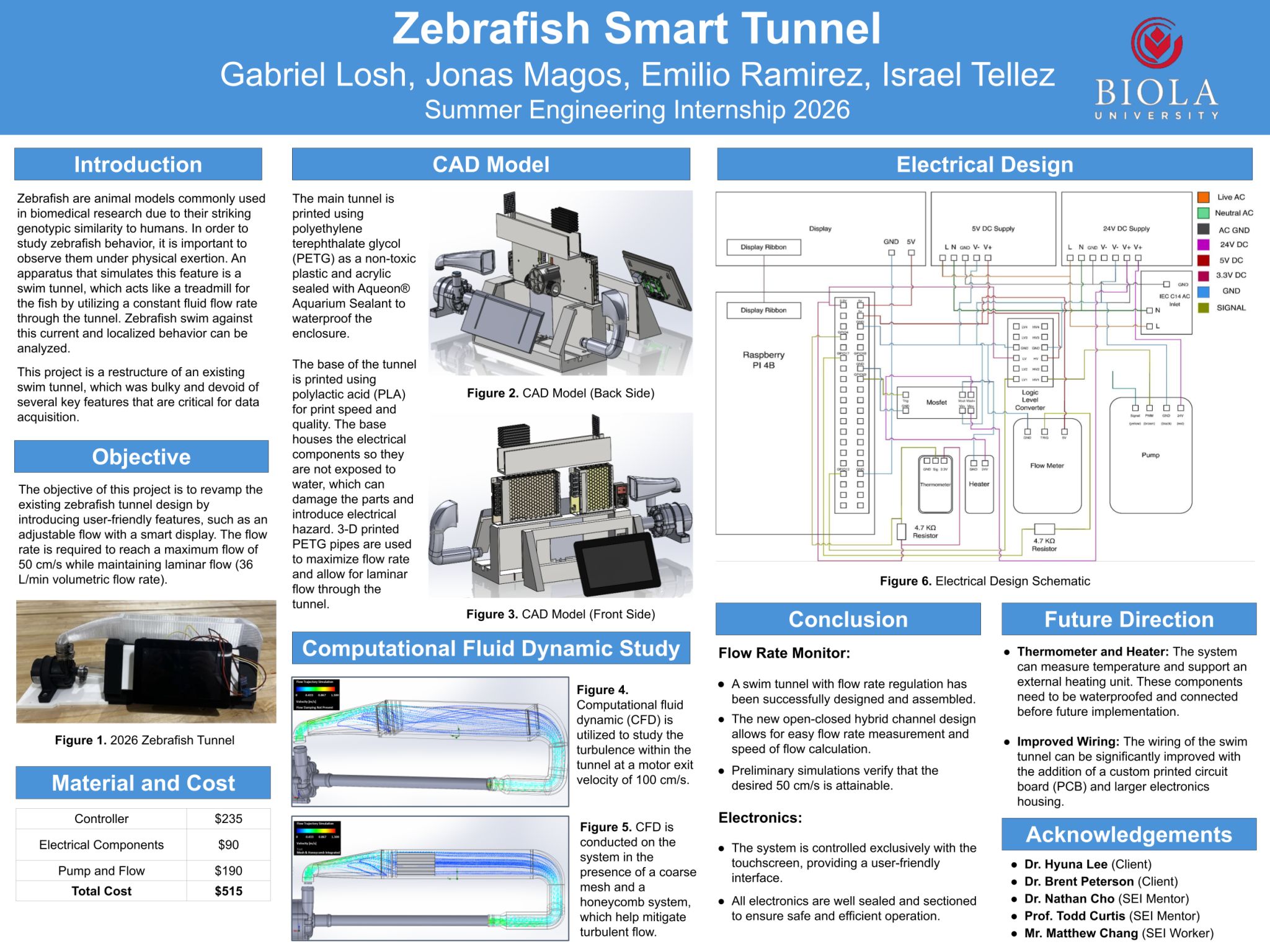
The team's first task was to define what "working" actually meant. The target they set: 50 centimeters per second maximum flow velocity, maintained in laminar conditions at 36 liters per minute. The original tunnel had no way to measure or sustain either.
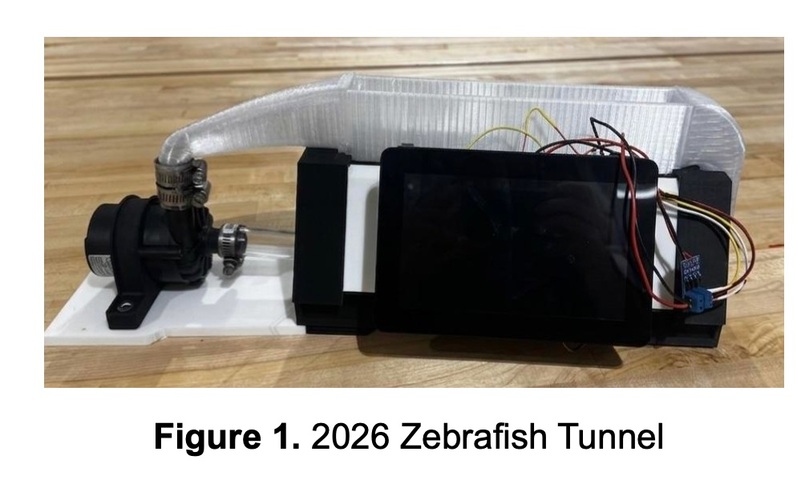
They designed the new tunnel body in computer-aided design (CAD) software and printed it in polyethylene terephthalate glycol (PETG), a non-toxic plastic sealed with Aqueon® Aquarium Sealant. The base, which houses the electronics and must stay completely dry, was printed in polylactic acid (PLA). Custom PETG pipes route water through the channel to maximize flow rate while keeping the current laminar. Before cutting any material, they ran computational fluid dynamics (CFD) simulations, studying turbulence at a motor exit velocity of 100 centimeters per second and installing a honeycomb structure inside the channel to break up turbulent flow. The simulations confirmed the target was achievable.
The $515 Zebrafish Tunnel
The finished instrument runs on a Raspberry Pi 4B. A touchscreen controls all functions: flow rate, pump speed, and display output. A flow meter tracks velocity in real time. An open-closed hybrid channel design enables direct flow measurement and speed calculation, the core capability the original tunnel was missing. All electronics are sealed and sectioned from water. Total build cost: $515, split across the controller ($235), electrical components ($90), and pump and flow hardware ($190). Future work includes waterproofing the thermometer and heater connections and replacing the current wiring with a custom printed circuit board.
"Their guidance challenged me to think more critically and approach problems as an engineer," said Ramirez of SEI mentors Prof. Todd Curtis and Dr. Nathan Cho, and SEI Worker Matthew Chang. "It was a meaningful opportunity to apply engineering to real-world challenges with lasting impact."
More from Biola's 2026 Summer Engineering Internship:
Explore Engineering at Biola →