Four seniors, one campus-safety requirement, nine months from drawings to flight.
John Ojeisekhoba was Biola University's chief of campus safety. His officers couldn't easily see into hard-to-reach corners of campus. That blind spot mattered most during graduation weekends and football games, when crowds grew large. Before he died in August 2025, he brought the problem to Biola's engineering faculty.
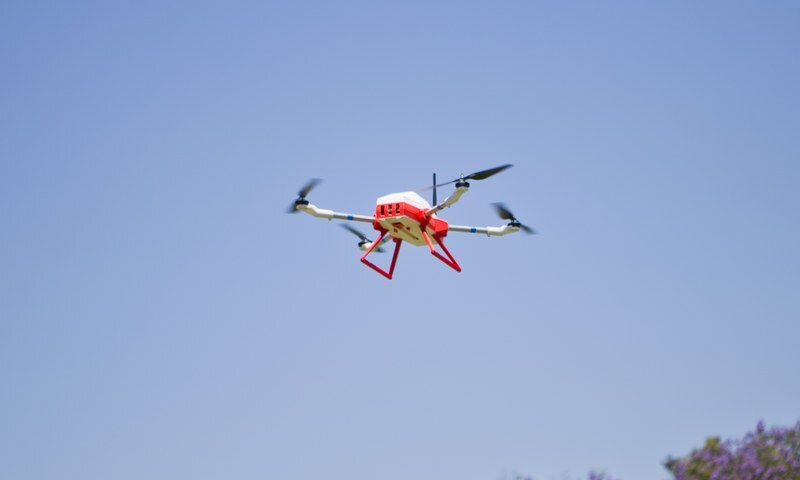
Four engineering seniors picked up the challenge as their senior capstone project (ENGR 470/471): Enqi Chen, Jordyn Fazekas, Nathan Griffin and Tyler Hill. Dr. Yohan Lee, associate dean of technology in Biola's School of Science, Technology and Health (SSTH), and Todd Curtis, professor of engineering, advised them. The students had nine months and full design authority. No finished product existed to copy from. It was a blank canvas. What they built is now called the O Drone.
The Requirement
Ojeisekhoba's request read more like a mission statement than an engineering brief. He wanted a way for Campus Safety to survey areas officers couldn't easily reach on foot. He also wanted faster support during large events. Neither goal came with numbers attached. So the students had to turn "hard-to-reach" and "respond faster" into real specifications: a 1.1-pound payload capacity and a 20-minute loiter time.
The Build
The team designed and built all 236 of the O Drone's structural parts themselves. They didn't buy a pre-made airframe kit. They used 3D-printed plastic (PLA and ASA), laser-cut plywood and aluminum tubing. For the electronics, they went the other way: they bought parts that already worked. A Raspberry Pi 5 runs the payload system. A Pixhawk 6C flight controller handles GPS, telemetry, LiDAR (a laser sensor that spots obstacles) and Remote ID, the FAA's required drone-identification signal. The team wired all of it together by hand.
That choice, build the frame, buy the electronics, freed the team to focus on the one part no vendor sells: a payload bay that swaps modules in and out. It uses a spring-loaded rail and two USB-C ports, one for data, one for power. Fazekas described the pace bluntly: "There was a lot of trial and error, especially in the later stages of development." The first module built for that bay was a thermal camera, a TOPDON TC001. It clips onto the same rail and streams video back to Campus Safety's ground control station.
Testing and Results
Eight requirement tests, eight passes.
The frame held up under stress first. The arm assembly took 29.6 pounds of force at the motor mount without breaking. It then survived 50 cycles of the throttle running from 0% to 95%. That is the kind of repeated strain regular patrol use would put on it.
Flight performance came next. Loaded to its full 1.1-pound payload limit, the drone produced a thrust-to-weight ratio of 2.17. That is well past the minimum needed to fly safely under load. Flying empty, it stayed airborne for 31.08 minutes. That beat the 20-minute requirement by more than 50%.
The swappable payload system held up too. It is the team's signature design choice. The mounting rail took 24.98 pounds of force without failing. It then passed 50 connection cycles, and the electrical contacts still worked afterward, confirmed with a multimeter. Swapping a module in or out took under 10 seconds across 20 tries. No tools or structural changes were needed.
Those numbers turn "swappable payload drone" from a design idea into a system Campus Safety can actually use.
The Team
Lee and Curtis advised the team, but they did not direct it. The four students split up the work themselves: one payload bay, one airframe, one flight test, built entirely on their own. There's a difference between being taught how a drone works and being responsible for whether one flies. That difference is most of what a capstone is supposed to teach.
What It Demonstrates
Biola's engineering program measures capstones against a specific bar: how fast a student can move from coursework to independent, client-ready work. The O Drone shows that bar in action. A real client brought a real, unclear problem to an undergraduate team. The team owned the design, worked through the failures, and delivered a tested, working system. No faculty member designed it for them. AI can help design a drone. It cannot take an unclear problem, work through nine months of failure with no playbook, and take responsibility for a system that actually has to fly. That is what Chen, Fazekas, Griffin and Hill spent the year proving they could do.
In Memory
Ojeisekhoba did not see the O Drone fly. He raised the challenge and died in August 2025, before the capstone that carried it forward was assigned. The students dedicated the finished drone to him. Read the full story of Chief Ojeisekhoba and the O Drone on Biola News →
Capstone Context
The O Drone is one project in Biola's 2026 senior capstone cohort. The same graduating class also built a Smart Greenhouse project. Each team worked from a real external requirement, not a simulated one. That is a deliberate structural choice in how Biola's engineering program runs its capstone year.
What's Next
The team has already planned its next version. It includes carbon fiber arms to cut weight, video transmission for first-person-view monitoring, and a landing-leg suspension system to reduce damage on hard landings. Separately, Southern California defense startups and U.S. Air Force UAS programs have shown interest in Biola's drone-production work, according to Biola News. That is an early signal worth watching as the capstone track keeps producing real, working hardware.
Study Engineering at Biola
The O Drone started as an ambiguous problem and nine months of undergraduate ownership. Study Engineering at Biola →