Three high school students from Lancaster, Brea, and La Habra arrived at Biola University on March 14, 2026, with a problem they wanted to solve and no experience building anything. By the end of the day, they had a working prototype, a first-place award, and a product aimed at the financial literacy gap that none of them had been taught to close.
The event was Biola's first AI hackathon for high school students, organized by Rita Koung and hosted by Biola University's School of Science, Technology and Health (SSTH) in partnership with Buildy.ai. It was free, open to California students in grades nine through 12, and required no prior coding experience. The day opened with a keynote from Dr. George Cheung, who introduced the Genius Project, a framework for understanding what humans contribute uniquely alongside AI. Bill McIntosh, founder of Buildy.ai, spoke next on entrepreneurial thinking and how no-code tools change who gets to build. Workshops on vibe coding, prompt engineering, app design, and problem identification filled the morning before teams spent the afternoon building. Buildy.ai, which donated platform licenses for the event, gave students the ability to move from concept to working prototype without writing a single line of traditional code.
"Most AI tools will write your code for you," said Darryl Jung, director of Biola's AI Venture Studio, "but they won't tell you what's worth building. What we saw today wasn't vibe coding. Students used Buildy.ai to surface problems they actually live, filtered through what they uniquely care about and where they've felt the pain, and then crafted a solution that fits them and their vision. That's when they stopped being users of AI and started becoming builders with it."
Two 13-Year-Olds and a Feature the Platform Had Never Done
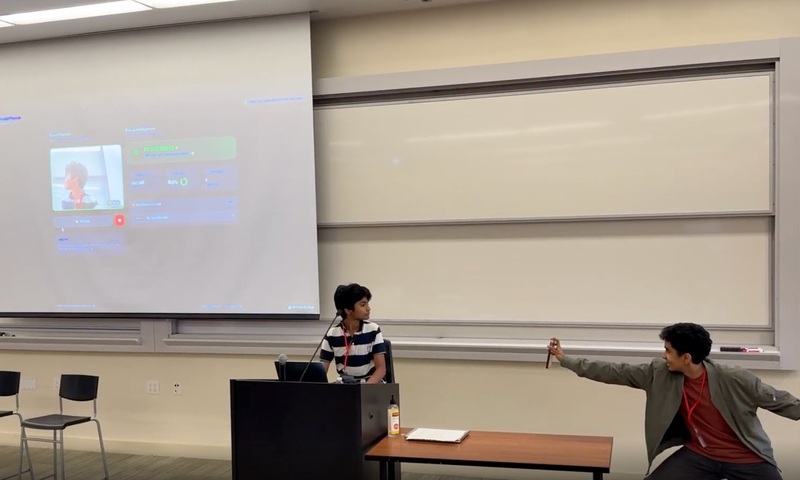
Yashvasin and Aneesh, freshmen from Whitney High School in Cerritos, arrived with a specific idea: a face-tracking app that would use facial detection to monitor a student's attention while studying and generate feedback when attention drifted. The concept addressed something familiar to anyone who has sat in front of material and realized, 20 minutes later, that nothing registered. StudyFocus was designed to catch that drift before it set in.
There was one problem. Buildy.ai had never been used for face tracking. No documentation existed, no precedent to follow. The two students worked through it in three hours and won the Most Technical award for doing something on the platform that no one had done before.
"This might be the basic steps for my future," one of the students said after the event. "After this, I'm going to work with AI a lot."
No Background, First Place
The team that won Best Overall came from three different cities: Lancaster, Brea, and La Habra. None of them had programmed before. Their project, Finance Coach AI, was an AI-powered financial coaching app designed for high schoolers, built around the financial literacy gap they had noticed in themselves. High school students graduate without knowing how to file taxes, manage a budget, or build spending habits that hold. The team designed it for a user they understood because they were that user.
They pitched to judges in the afternoon and won first place.
"I was a little bit nervous for her," said one parent after watching their child present. "She's very introverted and had no experience, and she blew our minds. She was up there speaking, fully engaged, and the website she created was absolutely phenomenal." Another added: "I was overwhelmed by her ability to communicate her project and delegate things to her teammates."
The Barrier That Wasn't
StudyFocus and Finance Coach AI didn't share a background. One team had some experience and pushed the platform past its limits. The other had none and won on the strength of their problem. What connected them was access: a free event, a no-code platform, and a reason to build.
"For many young people, entrepreneurship can feel intimidating or out of reach, especially if they don't know how to code or don't have the right tools," said McIntosh. "What makes an event like this so powerful is that the hackathon environment, combined with Buildy, gives students the support and leverage to think like entrepreneurs, build like entrepreneurs, and see that they really can bring their ideas to life."
A third team, How Do We Get There, won Best User Interface for a student support platform combining planning, wellness, career exploration, budgeting, and community features into a single experience. Three awards. Three teams. One requirement: a problem worth solving.
"Beyond building technology, we were establishing the character and identity of these students as problem solvers," said Jung. "They were affirmed by their peers with qualities like 'courageous' and 'charismatic,' words they would not have thought of themselves as. But as the day progressed, we were seeing those qualities emerge as they worked with their team, struggled through technical bugs, and presented themselves and their project."