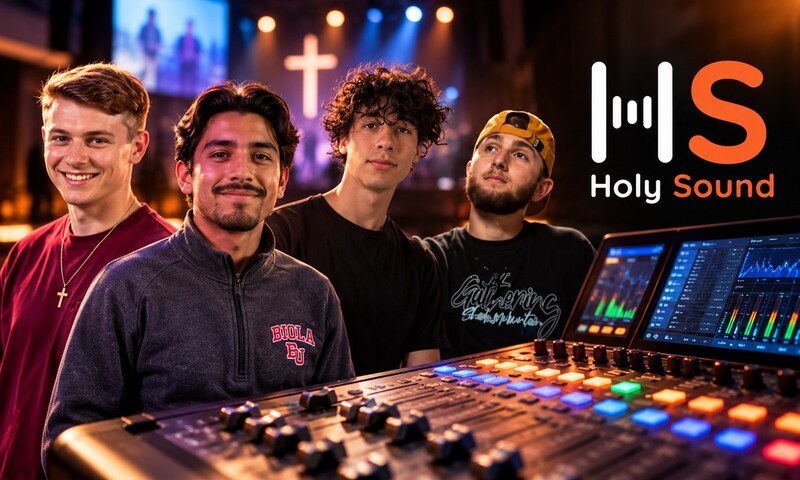
Ben Currie, a computer science major who also leads worship, built an AI tool that lets untrained volunteers run sound.
Most churches have one person who knows how to run sound, and when that person is out, nobody else can set up Sunday's service. Currie built Holy Sound to close that gap. It turns a plain-English description of a church service into a ready-to-run Ableton Live session, the same software professional sound engineers use.
Currie built it with Saul Hernandez, Louie Green and Everette James during Gloo's 2026 AI Hackathon, where the tool reached the finals of the Ministry Resourcing track. The event ran Oct. 6 to 8 in Boulder, Colorado. It's Biola's second straight year at Gloo, after two of the university's AI Lab teams won awards there in 2025.
The Sunday Morning Staffing Problem
Most churches run Sunday sound with one person.
"A lot of times in churches, you only have one audio engineer or one audio technician, sometimes two," Saul Hernandez, Currie's Holy Sound teammate, said of the problem the team set out to solve. Sometimes that person is out sick, running late or hasn't been trained on the board yet. Someone still has to set the tracks, balance the mix and EQ, or equalize, the room before the first song starts. There is no backup plan built into most church budgets. Hernandez and Currie had both seen it happen.
What Holy Sound Does
Holy Sound takes a plain-English description of a church service. That's close to how a worship leader would actually talk about a set list. It turns that description into a ready-to-open session in Ableton Live 12, the same software professional sound engineers use to run live audio. A volunteer who has never touched a mixing board can describe the service and get back a working session file.
The tool runs on Python, with Claude, Anthropic's AI model, handling the natural-language interpretation. Gloo AI Studio and OpenCode Go are both supported as alternative providers. Currie's public build log on GitHub shows more than 70 commits over the hackathon's 30-day virtual build period. That period started Sept. 8, ahead of the in-person finals in Boulder.
Hernandez framed Holy Sound's goal narrowly: cut the time it takes to set tracks and EQ a room. A sound engineer still makes every judgment call once the session loads. Hernandez estimated the tool can save "anywhere from six to seven hours on a Saturday for just one person." Gloo's hackathon was built for exactly that kind of test: prove an idea can work, not ship a finished product. Holy Sound's working proof of concept did that. It's one step closer to closing the missing-audio-tech gap for good.
A Computer Science Major Who Leads Worship
Currie owns the project's public GitHub repository and led the build. He is a computer science major at Biola. He also serves as a worship leader and studies worship arts, a combination that shaped what the team chose to build.
A purely technical team might have built something impressive to other engineers but irrelevant to an actual Sunday morning problem. Currie had stood on the other side of the soundboard, and that firsthand view shaped what the team prioritized. Hernandez wrote the code for Holy Sound's chat interface, live mixer and AI-assisted import. Additional team members included Cinema and Media Arts student Louie Green and Worship Arts student Everette James.
Built in 30 Days, Judged in Boulder
The Gloo AI Hackathon drew more than 1,000 builders across 115-plus teams from 12 countries and 34 states this year. They competed for $200,000 in total cash prizes under the theme "Building Together: Humans, Agents and the Future of Flourishing." It was the event's fourth year running.
Biola fielded three teams in 2026: Holy Sound, Terra and Selah. Holy Sound reached the finals of the Ministry Resourcing track. It is Biola's second consecutive year sending teams to Gloo. The Biola AI Lab's first trip, in 2025, ended with two projects winning awards. Flora and Ephphatha combined for $15,000 across the Vibe Coding and Hacker's Choice categories.
Dr. David Bourgeois, director of Biola's AI Lab, said sending students serves a broader purpose than winning. "We want to expose our students to this, not just, you know, because we want them to win and represent Biola, of course, all of that, but also so they actually can experience an environment where they meet other professional Christians who share the same goals, who want to serve the Lord through business, through technology, through AI," Bourgeois said. "I'm really proud of our teams, the way they represented Biola and the way that they're representing God's kingdom in the world through what they're building here."
Dr. Silvia Mah, director of Biola's Office of Innovation, watched the same pattern play out across all three Biola teams. "You see how brilliant every single student here is," Mah said. "They're flourishing in their God-given talents, and you cannot create that in a classroom." She added that students were "seeing themselves work together better," alongside professionals "five years, 10 years ahead of them working well in the glory of God."
What a Working Build Actually Shows
What Holy Sound does show is a working prototype for a real-world problem, built in 30 days of virtual work plus a 48-hour sprint, with a public commit history anyone can check. The team found a real ministry gap and built something that solves it. Getting there took more than code.
Currie's computer science training gave him the tools to build Holy Sound. Leading worship gave him something a technical skill set alone doesn't: the standing to know exactly what a volunteer needs on a Sunday morning, and the conviction to build for that volunteer specifically, not a general audience. Hernandez brought the same focus to the code itself: the chat interface and live mixer he wrote stayed anchored to what someone with no training could actually run, not what was technically impressive to build. That conviction, the focus on an actual sound tech instead of a general audience, is what AI wouldn't do on its own. At scale, Holy Sound could save volunteer sound techs six to seven hours a week, giving congregations more room to actually experience the service, holy sound included.
Students weighing a computer science or engineering track against a ministry calling don't have to choose one. Biola's AI Lab and Office of Innovation are where that combination gets tested against real deadlines and real teams.