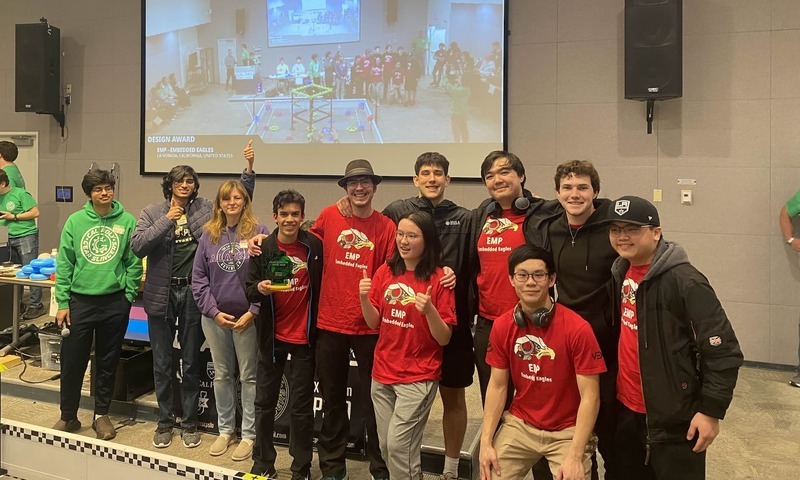
After winning the Design Award at a VEX U regional in San Luis Obispo, the team headed to Dallas.
Biola's robotics team left with a Design Award, second place in the California Skills event and a top-25 national ranking. That earned them an invitation to the 2025 VEX Robotics World Championships in Dallas.
VEX U is the collegiate division of the VEX Robotics Competition, one of the world's largest robotics programs for students. Teams build their own robots and compete in engineering challenges. Judges score design notebooks, programming and performance on the field. Regional tournaments like the Gear Slingers Open decide which programs earn a spot at the World Championship. It's held in Dallas each May. To qualify from a single regional, a team has to rank at the top in both skills and design, and Biola did both. Biola News first reported the result that April.
The team's edge was the investment they made in autonomous capability.
Timmy and Ricky were Biola's two robots for the 2025 season. The team built them with AI and autonomous systems that went beyond a standard competition build. In VEX U, robots operate in both autonomous and driver-controlled periods. The teams that win skills rankings usually have the most reliable and most aggressive autonomous routines. Biola's team chose to push there.
"They saw the opportunity to exceed the competition by outcompeting peers with creative AI and Autonomy embedded into their robot," said Dr. Yohan Lee, associate dean of technology. He was one of three faculty advisors on the team. A NASA Jet Propulsion Laboratory reviewer looked at the field and reached the same conclusion. The reviewer credited the team's "sophisticated Computer Science and AI" for the edge it gave them over more well-known programs.
Biola won the Design Award at the Gear Slingers Open. It goes to teams that show engineering excellence in how they design, document and improve their robots. Tournament officials review design notebooks and interview team members on their process.
Nine students built Timmy and Ricky. The club goes by a name of its own: EMP, short for Engineering Meets Programming.
Ryan Ong, a computer science major, was captain and lead programmer. Jaran Mann, a robotics major, was the other captain and the primary driver. J.T. Lam, studying engineering physics, led mechanical design. Christian Meineke, Tyler Hill and Yile Lin, all engineering majors, filled out the technical build team. Chris Gruytch contributed on the programming side. Ben Stewart, a cinema and media arts major, was the ninth member.
A student from Biola's film program helped build a robotics team that reached the World Championship. That kind of mix across majors shows up often on Biola's teams.
Mann founded the club himself. He arrived at Biola in fall 2023. He was the first student to declare its new robotics engineering major. He started a team because none existed yet. He came to Biola from Valencia High School. There, he drove for the school's FIRST Robotics team before moving into a mechanical lead role. Robotics runs in the family. Mann's great-aunt, Christine Mann Darden, spent 40 years at NASA researching aerodynamics and supersonic flight.
The team worked under three faculty advisors: Dr. Genti Buzi, Dr. Yohan Lee and Dr. Grace Ni.
The 2025 VEX Robotics World Championship was held in Dallas, Texas, on May 9, 2025. It draws qualifying teams from regional and national tournaments across the United States and abroad. The programs that showed up to compete alongside Biola included teams from large engineering schools and research universities.
Biola arrived ranked in the top 25 nationally in skills. That ranking came from a single regional tournament. On the same day, the team beat out well-known programs from California Baptist University, Mt. San Antonio College and Cerritos College to qualify.
Dr. Matthew Rouse, dean of the School of Science, Technology and Health, called the run "simply amazing" when it happened. He pointed out that Biola's robotics engineering degree had only launched in 2023. The club itself had formed just the year before.
The Worlds qualification is one chapter in a longer robotics story at Biola. In the year that followed, the university received its first humanoid robot. It's an investment that expands what students can build and what the program can become. The qualification, the humanoid robot and the projects that followed are cataloged together on Biola's robotics engineering page. It's the ongoing record of what the program is building toward.
If you're a prospective student: The nine students who built Timmy and Ricky came from computer science, robotics, engineering physics and cinema and media arts. No single major owns the robotics program. What got this team to Dallas was a shared decision to invest in autonomous capability. Faculty advisors Dr. Genti Buzi, Dr. Yohan Lee and Dr. Grace Ni helped them pursue it. If you want to work on robotics at a competitive level, start early. The Robotics Club takes students from their first year at Biola.
If you're an employer or recruiter: The team that placed in the top 25 nationally built their autonomous edge by choice. They found the edge that mattered, built AI into their robot and followed through. Ryan Ong, Jaran Mann, J.T. Lam and the six others brought those skills into a national competition. They won a Design Award doing it. That is the same kind of decision-making and teamwork this group will bring to your engineering floor.
If you're a parent or donor: The Gear Slingers Open and the VEX Robotics World Championship are the same tournaments where large, well-funded engineering schools compete. This team earned a top-25 national ranking at that level, with a fraction of the money and staff those programs have.