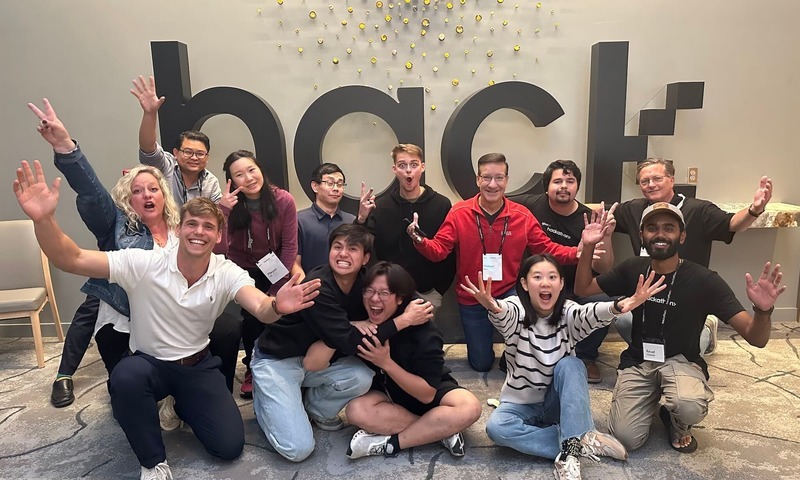
On October 10, 2025, 98 teams gathered in Boulder, Colorado for the GLOO AI Hackathon: 700 competitors from 48 states and 27 countries, nine awards on the table. Biola University's AI Lab sent two teams. Both came home with a check.
The Hacker's Choice Award went to Ephphatha, a system that translates live speech into three-dimensional American Sign Language displayed on screen, built so Deaf and hard-of-hearing congregants can follow sermons, prayers, and songs in real time. The Vibe Coding category first place went to Flora, an AI-powered app that guides users through reflection on their technology habits using an animated character called Flora the Focus Fox. Ephphatha won $5,000. Flora won $10,000.
GLOO is an organization focused on Christian perspectives on human flourishing and the role of AI in advancing the global church's mission. The 2025 hackathon drew competitors from 48 states and 27 countries to build applied AI solutions, most of them aimed at problems that faith communities and the people within them face. Biola entered through its AI Lab, a student organization within the Crowell School of Business that prepares teams for national competitions and gives students the structure to build work the classroom alone doesn't produce.
Why Mixing CS and Business Students Won
Matteo Mellilo, En Duo Wang, Ryan Ong, and Caleb Ayers built Ephphatha. All four are computer science majors, and the problem they chose to solve is hard. Sign language is three-dimensional: it uses handshapes, movement, and facial expression simultaneously, and rendering it accurately enough to be readable on a two-dimensional screen during a live service is not a standard engineering exercise. Their system takes spoken audio, processes it in real time, and outputs a 3D avatar producing the corresponding ASL, frame by frame, as the service is happening. What made Ephphatha win the Hacker's Choice Award was the specificity of the use case, not the technical architecture alone: they built for a particular person sitting in a particular pew, and the need was visible to anyone in the room.
Flora's team crossed three schools. Stefan Jungmichel, the AI Lab's Associate Director and an MBA graduate from Biola's Crowell School of Business, led a group that included Megan Lai in computer science, Ben Currie in worship arts and Felicity Zhang in business administration. The product they built asks users to assess their own technology habits through self-reflection check-ins, then uses that input to generate personalized wellness and productivity goals. The Vibe Coding category judged working prototypes, not design documents. Winning it required more than functional code: someone on the team needed to understand product viability, user behavior, and user interface.
We believe that it is imperative for our students to participate in the conversation about how AI can be used in alignment with biblical values said Dr. David Bourgeois, AI Lab Director.
One Team Kept Going
For Ephphatha, Boulder was not the end. The same team carried their voice-to-ASL system into a startup competition after the hackathon and won an additional $7,000, with judges reaching the same conclusion the GLOO competitors had reached: the problem Mellilo, Wang, Ong, and Ayers chose to solve was real, and what they built was ready to compete. The full arc of what Ephphatha became after Boulder is documented separately.