Biola's Summer Engineering Internship puts lower-division undergraduates into client-driven research. Emilio Ramirez on Zebrafish, Automotive Suspension, and Clean Water
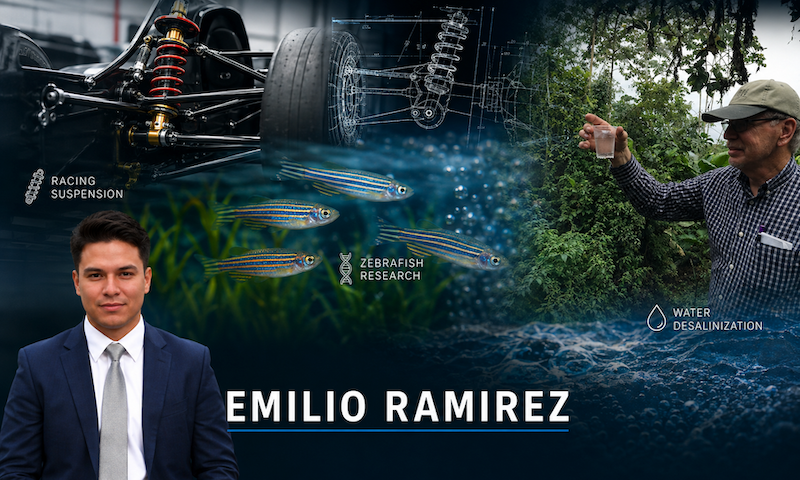
In one summer, a Biola engineering student ran three research projects for three different clients: a swim tunnel for zebrafish behavioral studies, a kinematic model for a racing team's suspension, and a water purification upgrade for a Christian NGO serving rural Colombia.
Emilio Ramirez, a Mechanical Engineering junior at Biola University, completed all three through the Summer Engineering Internship (SEI), a program run through the School of Science, Technology and Health (SSTH) that places lower-division undergraduates into client-driven research before they reach senior capstone. The three projects ran in the same summer, each with a different sub-team, a different technical domain, and a different client.
Three Projects, One Summer
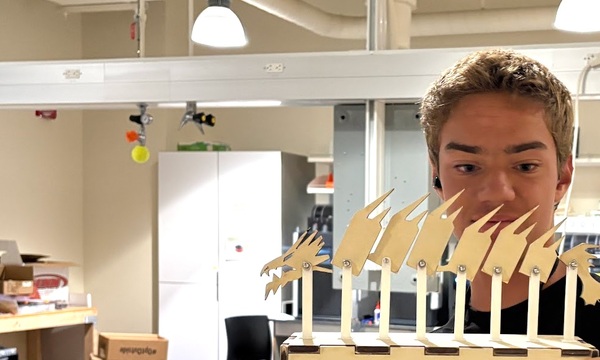
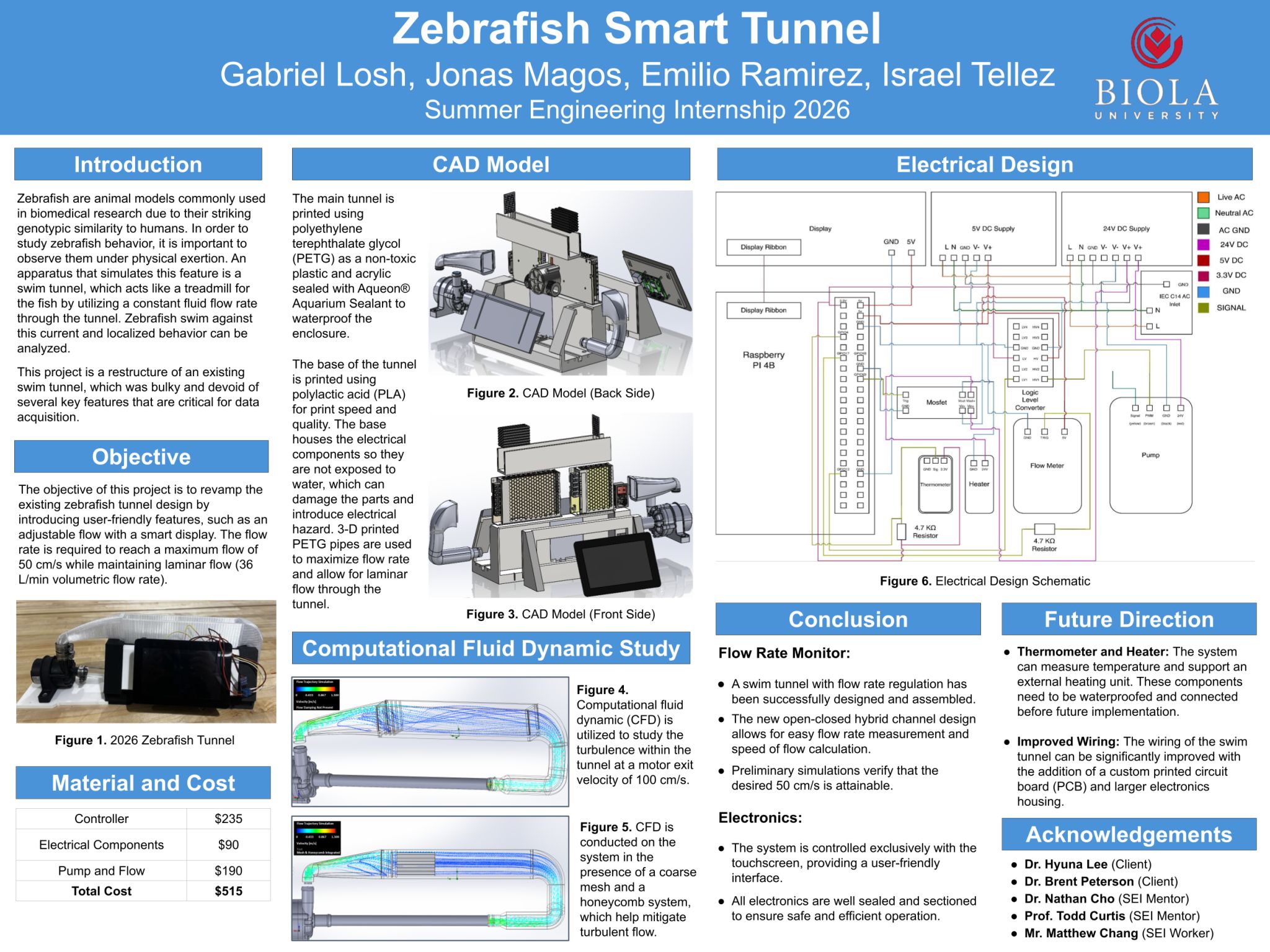
The first came from biology. Dr. Hyuna Lee (Biological Sciences) and Dr. Brent Peterson (Kinesiology and Public Health) needed a controlled environment to observe zebrafish under steady, measurable flow. Working with Gabriel Losh, Jonas Magos, and Israel Tellez, Ramirez applied computer-aided design (CAD) modeling, computational fluid dynamics (CFD) simulation, and Raspberry Pi touchscreen control to build the Zebrafish Smart Tunnel, a prototype that validated laminar flow at 36 liters per minute. Commercial alternatives cost $30,000 or more; the team delivered a working unit for $515.
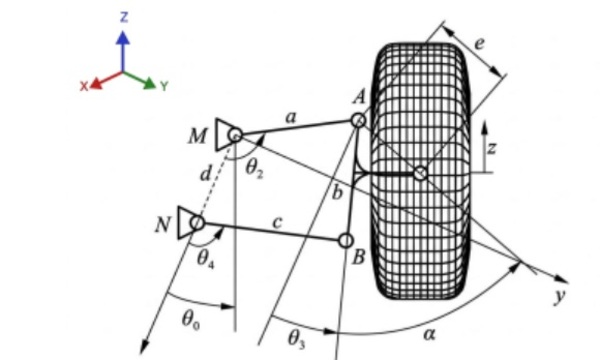
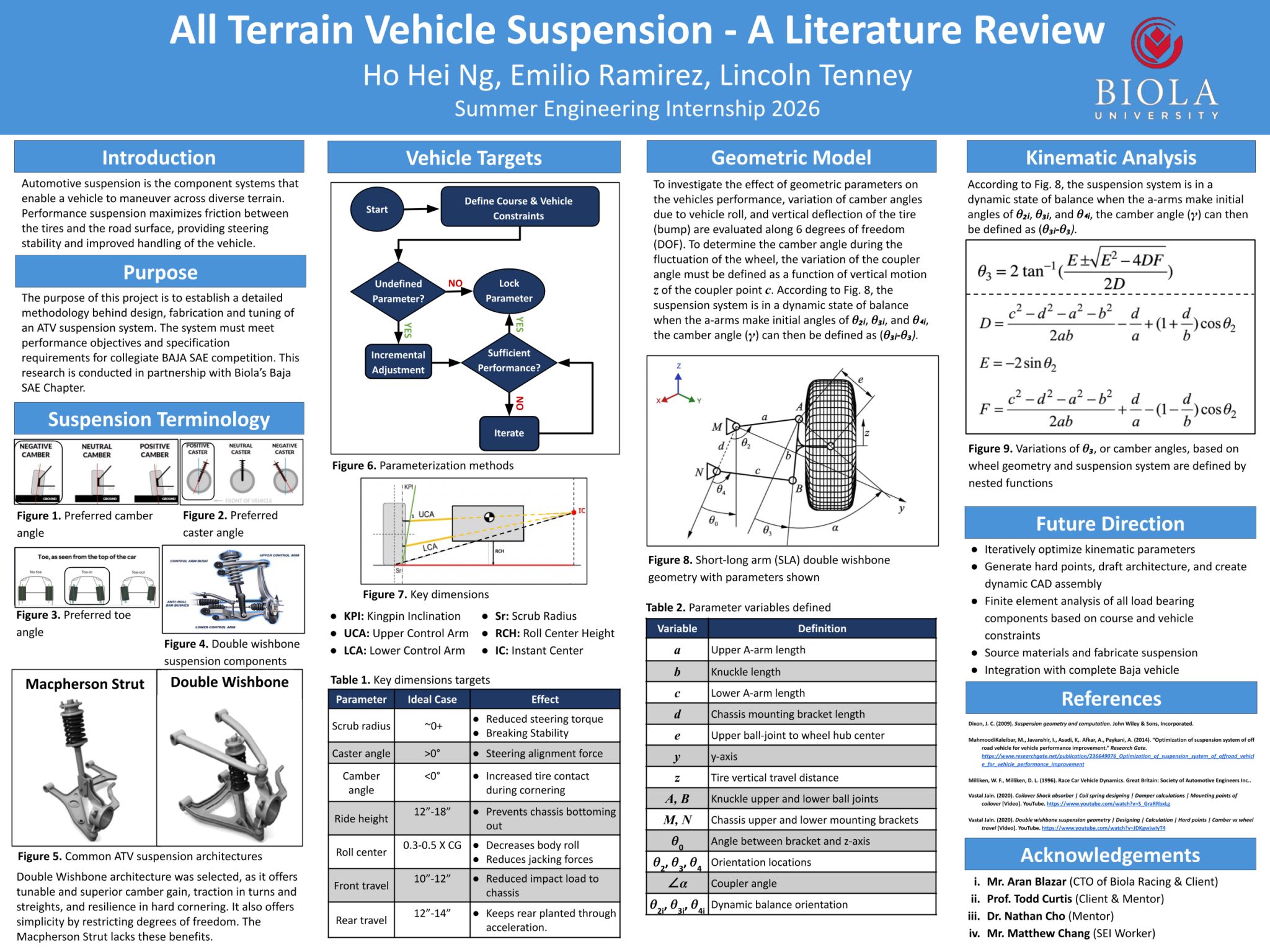
The second moved into vehicle dynamics. With Ho Hei Ng and Lincoln Tenney, Ramirez conducted a kinematic analysis of all-terrain vehicle suspension systems for Biola Racing, Biola's Society of Automotive Engineers (SAE) collegiate chapter. The team evaluated a MacPherson strut design and a double wishbone design, selected double wishbone, and delivered a validated parameter set covering ride height, camber angle, caster, scrub radius, and front and rear travel targets that the Racing team can take directly into fabrication. Ramirez is Vice President of Biola Racing's SAE chapter, which meant he was producing research for a team he leads.
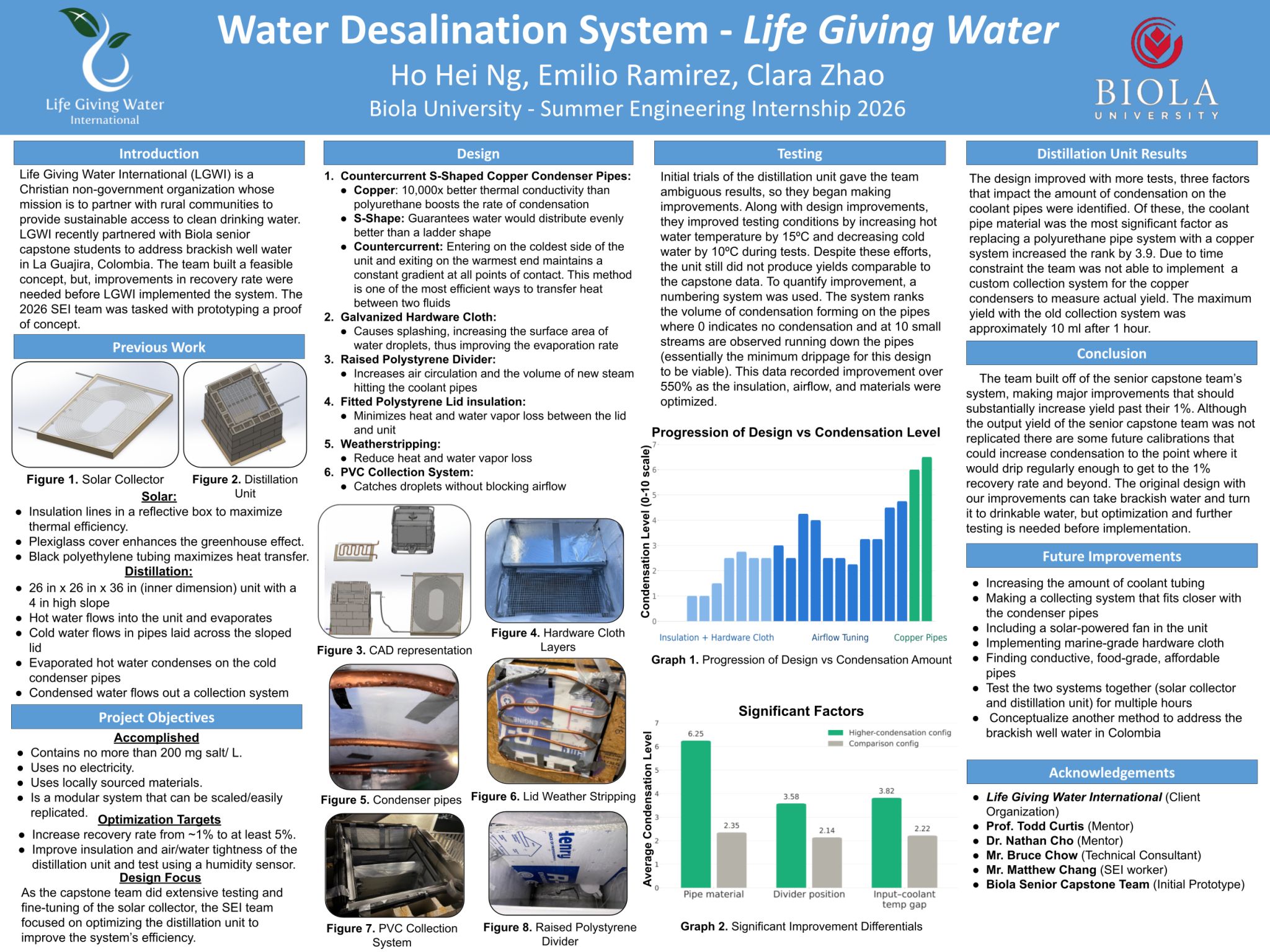
The third addressed clean water access. With Ho Hei Ng and Clara Zhao, Ramirez upgraded the distillation unit of a solar desalination system built for Life Giving Water International (LGWI), a Christian non-governmental organization working to bring clean water to brackish-well communities in La Guajira, Colombia. A prior Biola capstone team had established the base system. The SEI team was assigned to improve its condensation performance using locally sourced materials and no electricity. Switching from polyurethane condenser pipes to copper, which conducts heat approximately 10,000 times better, improved condensation by more than 550% across design iterations.
What the Work Required
Across three projects and three technical domains, Ramirez drew on CAD modeling, CFD simulation, rapid prototyping, kinematic analysis, design of experiments, and technical communication. Each project used different methods and a different sub-team; none of the teammates from the zebrafish project appeared on the suspension project, and neither group entirely overlapped with the desalination team.
"Throughout the summer, I strengthened my skills in engineering design, research, CAD modeling, CFD simulation, rapid prototyping, and systems thinking," Ramirez said. "Most importantly, I gained a deeper appreciation for using engineering to develop solutions that can improve lives and advance scientific discovery." Of his mentors, Prof. Todd Curtis, Dr. Nathan Cho, and SEI Worker Matthew Chang: "Their guidance challenged me to think more critically, approach problems as an engineer, and continually pursue excellence."
What's Next
Ramirez continues as Vice President of Biola Racing's SAE chapter into the fall, where the suspension parameter set his team validated is now part of the chapter's fabrication planning. Senior capstone is ahead.